17
TOWARD A NEW SOCIO-POLITICAL VISION FOR ASIA-PACIFIC
Ed dela Torre
[Note: This write-up puts together the ideas of
the participants and the ideas of the resource person. It is an attempt at a
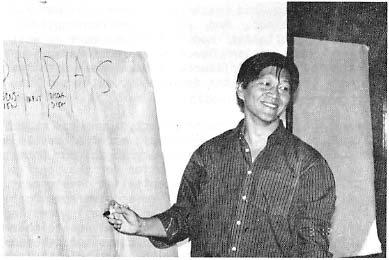
synthesis at the end of a popular education process called ADIDAS (Activity
Discussion/Input/Discussion/Activity/Synthesis].
Roots: Starting
Points
"Socio-political
includes two elements: social and political. "Social"
usually refers to society (whether local community or a whole nation/country),
and "political" usually refers to government and the state. We want
to envision what kind of societies and governments we want in our individual
countries, in the Asia-Pacific region and even the whole world.
But before
going into "visions" (with its image of minds soaring in the sky) we
need to examine where are we starting from, the ground
on which we stand, our roots. [The participants were asked to group in
country-pairs: Korea/Japan, Taiwan/Hong Kong, Thailand/Burma,
Philippines/Indonesia, Singapore/Malaysia, Australia/Aotearoa-New Zealand/Fiji,
Sri Lanka/Bangladesh/India. They were to identify the
social categories they consider most important to them, and also give the
connotations, good or bad, that politics has for them. Finally, they were asked
to describe whatever political involvement they have had so far].
The responses
on social identities revealed a great unevenness of experience and
consciousness among the participants. The majority had a very strong
consciousness of race, religion and culture. I was personally surprised that
not many gave the nation/country as the most significant category. Class was
also mentioned only by a minority. One emphasized being a student (with
examinations as hell). There are two ways to look at these answers. One is that
most participants are still at a '"pre-political" stage, not quite
conscious either of class structures and location, or even of the nation. In a
later discussion, some did talk about the problem of Westernization. On the
other hand, the emphasis on race, religion and culture might be fertile ground
for a conceptualization of politics not merely within the traditional framework
of class and nation-state, but appreciating the politics of various social
identities.
The
connotations of politics follow logically. Participants expressed a strong
sense of alienation (feeling indifferent, sick and tired) about politics as
being bad. Their critique of government and politicians ranged from being
"silly and playing games", to being "corrupt and
unethical", not representative or responsive to people, exploiting youth
and teachers, repressive and colonial. The different
18
emphases of their critique reflected specific national
contexts. One participant pointed out that once certain economic policies are
adopted, politics will follow their logic.
Politics as
good evoked a narrower variety of connotations. In fact, we can reduce the
participants' responses to two. One is participating in the formal democratic
processes (like voting) and appreciating the formal freedoms, including the
role of law and government policies in promoting social peace and social
justice. The other is participating in movements for change,
"andolan", and other opposition activities, open or secret.
Framework: Decolonization,
Development and Democracy
I drew three
overlapping circles as a framework for discussing three themes that should be
part of our new vision. One circle is decolonization; the second is
development; the third is democracy. Given the multiple and often contradictory
meanings associated with development and democracy, I added some qualifiers at
the end of the input: (a) development as equitable and sustainable, and (b)
democracy as people's empowerment and participation.
DECOLONIZATION DEMOCRACY people’s
empowerment people’s
participation DEVELOPMENT equitable sustainable

Decolonisation,
at first glance, would seem to be an outdated issue. All countries in
19
Correspondingly,
decolonisation has many facets. I chose to concentrate on the cultural aspect,
the task of inner decolonisation, partly because the participants are students
and intellectuals, partly because of their strong consciousness of race,
culture and religion. Even if we look at foreign and Western influence as
"benign", the problem with colonisation is that foreign influences
have come into our lives forcibly without regard to our own capacity to
organically absorb them and to choose critically. It is like being force-fed.
Food comes from the outside (like foreign influence), and if we freely take it
in according to our capacity, we chew and digest it, absorb what we need, and
eliminate what we don't need. But when we are forced-fed, we end up being
constipated. Once we become aware of that we are constipated, what is the
"rational" human response? Not selective and critical choosing of
retaining some and eliminating others. No, the rational response is, first of
all, total elimination!
But of
course, we do not stop at the total elimination; we move on to selective and
critical absorption of foreign influence. The same holds true for nationalist
anger at foreign domination and discrimination. After a while, we need to go
beyond the anger, to quietly and confidently affirm our own worth, the value of
our cultures and identities.
Colonial
mentality, reinforced by colonial education, can have very material
consequences for the development or lack of development of our societies. The
so-called brain drain e.g.. there are more Filipina nurses in the
20
Christianity
has its role both in colonialism and the assertion of national identity and
dignity. There is a need for incarnation, if Christianity is to be part of the
liberating influences in
The year
1992 gives another angle to decolonisation. The 500th anniversary of the
colonisation and christianisation of the South by the North should remind us of
the historical association of colonialism not only with Christianity but with
capitalism and the white race (others would add the dominantly male character
of the colonial and capitalist enterprise). Hence decolonisation addresses not
just racial domination, but the role of our native pre-Christian religions and
culture. And what about social systems? Do we retreat to pre-capitalist
systems? Can we envision a social system beyond capitalism, learning lessons from
the achievements and failures of socialist experiments, especially in
Decolonisation
is inseparable from development. It is difficult to assert independence and
national dignity, if our resources and people are being drained. And yet we are
confronted by the harsh reality that the capitalist model of development is
what dominates the thinking of most Asian leaders, and most Asian people who
are exposed to the constant influence of mass media with its images of
development and progress in the developed countries of the North and in
Of course
the persistence of poverty among the majority of our people in itself offers a
critique of this model of development which produces inequality as part of Its
very logic. Our Christian faith that calls us to take a preferential option for
the poor is a further source of critical thinking about capitalist development.
Since we are middle class students, we expect to acquire some
"capital" initially in the form of skills. Franz Fanon had an
interesting metaphor about us. We, who have acquired some capital, can either
choose to invest this in the dominant system, so that we can be small
shareholders. It is low-risk investment, with short-term, low-returns. Or we
can invest our capital in the potential of our people. It is high-yielding; but
it is long-term, and also high-risk.
21
In 1992
there will be a United Nations conference on environment and development in
For
development to be equitable and sustainable, there is a need for democracy.
Even the dominant nations have changed their mind about democracy in the South.
There was a time when they would support dictatorships and authoritarian
regimes, saying that democracy is a luxury for underdeveloped nations, and that
such governments can better insure development. Now, the same dominant
governments that supported dictatorships are professing their commitment to
democracy. However, they usually restrict it to the more formal aspects of
democracy so that some scholars have aptly called it “low-intensity
democracy".
Our new
vision of democracy understands it as "people's empowerment" and
"people's participation". Instead of looking only at democratic forms
of rule "from above", we emphasize democracy "from below"
in the form of people's organisations, in partnership with non-governmental
organisations who can pressure governments to formulate and implement policies
that benefit the people. For people's organisations to do this, they need
popular education on various issues and the formation of grassroots leaders who
can address both local and national issues, and can lead their communities in
negotiating with outside power holders.
I did not
add a forth circle to represent the feminist aspect of our vision. Instead, we
should see the feminist vision as a second set of three circles that coincide
with the three circles of decolonisation, development and democracy. Unless we
can integrate gender consciousness and equality in our vision, it will be less
than what
Contextual Spirituality (Some
reflections on Philippians 2)
The central
passage in Philippians 2 calls on us to be humble and "think of others as
better than yourselves". We are presented with the example of Christ who
"emptied himself and took the form of a servant".
I want to
give a very brief comment about "context" and its importance in our
reading of the text. Read within a religious context, especially against the
background of religious teaching that warns us against the capital sin of
"pride", the text yields a clear and welcome message. .
22
But if we
read the text in the context of our discussions about decolonisation and the
need to go beyond anger, to affirm quietly our sense of self-worth and dignity,
the advice to "think of others as better than yourselves", especially
when spoken by a foreign missionary to Asians who are still in the process of
decolonisation can be jarring. On the other hand, in the context of the
relationship between a middle class intellectual and the poorer majority whom
s/he would like to serve, the text speaks a necessary caution against thinking
that we have nothing to learn from the poor.
A second
point I'd like to share is the tension between two poles of Christian
spirituality. One pole of spirituality is emphasised in the text -
"self-sacrifice". Its importance has been underlined by some of you
who describe how difficult it is for Christian students to go against the
prevailing atmosphere in campuses, with the emphasis on getting ahead and
achieving as much as possible. But I would like to point out that there is a
second pole of Christian spirituality - "self-fulfilment". We can
cite Christ's words in John, "I have come that they may have life and life
in its fullness". There is no easy formula for handling the tension
between these two poles. If we emphasise only self-sacrifice, we become
vulnerable to the so-called "gospel of wealth and power" which
declares that "You are born champions! You are born of the one sperm that
beat millions of other sperms and fertilised the egg!" On the other hand,
if we emphasise self-fulfilment, we may be reinforcing self-interest and breeding
illusions about a path of service that is without sacrifice. It is a bit like
the tension between the message about crucifixion and resurrection.
A third
point will take a bit longer to present. First of all, I'd like to
contextualize my reflections about spirituality in the framework of a
"movement", since all of you are interested in helping build a
movement of youth and students. In the
AROUSE ORGANISE MOBILIZE
23
In trying to
explain political concepts and processes to young people who may not be very
interested in politics, and who are "turned off" by political
language, I follow the advice of a veteran community organiser and communicate
in the "two universal human languages" of sex and toilet!
"Arouse"
is equivalent to the stage of getting a crush, of being emotionally attracted
to someone. How and why does one get attracted? There is no systematic process;
it varies from individual to individual. One might like the face, the eyes; one
might like the voice or legs. (I once read that the Japanese men like the back
of the neck of Japanese women!) What this means for us is to be flexible about
getting young people Interested in issues of justice and joining a movement.
One might be interested because a friend is in the movement; another might be
angry at some injustice; still another might be feeling guilty about being
middle class. Don't expect the first motives to be "noble" or
theological. What matters is that they are aroused, motivated, feel strongly
enough to want to do something.
In fact,
there is an Insight from community organising that is worth knowing. In
community organising, we distinguish between "problem" and
"Issue". We say that people act not on problems but on issues. (This
is not a dictionary distinction.) Problems are easy to identify – injustice,
pollution, landlessness, etc. The tendency of Intellectuals like us is to study
problems, since we know that they are connected to one another and complicated.
Hence our first response is to have a workshop. That is useful, but it does not
necessarily lead to action. Part of the reason is that as we analyse, we feel
that they are overwhelming problems, beyond our capacity to address. There is a
saying about "analysis that leads to paralysis".
A problem
becomes an issue when: (a) you feel, personally affected by it; and (b) you
feel you can do something about it. And if there are others who also feel
personally affected and who also feel they can do something about it, then you
can act together as a group.
"Mobilize"
is like going out on a date. You act on your initial feelings to test them
through action. If the "mobilization" is good, then you are further
aroused, and want another mobilization. It can happen that you may be impatient
and want to do too many things too fast (in politics, it is called the
"ultra-left" error); that might be the first and last mobilization.
On the other hand, you might have gone out on 12 dates, and yet be doing
exactly the same thing over and over without any variation. This could also
mean the end of further arousal and mobilization!
Finally, you
get "organised". This is like making commitments (not necessarily
formalized, as in marriage); you set schedules to meet regularly. You start
also organising your feelings and motives, to get to know each other "more
systematically". In personal relationships as
24
in organisations, what is important is not to see organisation as the end
of a linear process that starts with arousal and mobilization, so that once
organised, you do not pay attention anymore to arousal and varieties of
mobilization. It's like having sex simply because it is the schedule! Regular
becomes "ritual" in the worst sense of the word; this is especially
true of meetings.
What has
this context to do with Philippians 2? Actually, it has something to do with
both Philippians 1 and 2. I was struck, while preparing for this talk, by the
seeming contradiction between Paul's comments in chapter one and chapter two.
In chapter one, he seems to pay less importance to motives so long as the
action and effects are okay. He talks of people preaching the gospel for
different motives – some good, some bad. Never mind, he says, so long as the
gospel is preached. But in chapter two, he advises us to insure that our
motives are good. That is the more usual tradition in our formation – to
"purify" our motives.
Based on my
experience in organising and reflecting deeper into how Christians have been
involved in the struggle for justice. I am convinced that while there is one
Spirit, there are many spirits that drive us and move us to action. Not all of
them are as noble as we would want, like faith, hope and love. They include
shame, guilt, pity, anger, etc. Our task, I think, is not so much to
"purify" our motives i.e. discard or suppress what seem to be lees
noble ones; but to recognise them and "organise" them – i.e. to
insure that the nobler motives are the lead motives and the others are
subordinate. These are tentative ideas, but I offer them for your reflection.
Visions: National, Popular,
Global
After the
inputs, participants had another discussion-activity. Using the framework of
"national-popular" as two poles of their commitment and vision, they
were asked to spell out their hopes and concerns. If they had time, they were
also asked to contribute something to a global vision.
The
responses again reflected the different contexts of the participants but they
can be clustered around key visions. Around the "national" pole, the
first vision is of national independence and self-determination. The second, is
of self-reliant economy and economic justice. The third is of democracy with
special mention of people's awareness and participation. Closely related to
this is pluralism, with special reference to indigenous people and minorities.
Finally, a vision of peace, based on justice and opposition to the use of
"self-defense forces" for overseas "peace-keeping".
Around the
"popular" pole, a further fleshing out of a vision of democracy, to
include freedom of opposition, respect for human rights, people's empowerment
and respect for different faiths. The vision of
25
economic justice also gets specified: eradication of poverty, provision
of basic needs, social services, jobs, no threat of demolition, genuine rural
development, a housing program. Environmental Issues get special mention
together with concern about nuclear power plants and waste dumps.
Understandably, education is given due Importance, to Include teachers' unions.
There is concern for AIDS and prostitution. There is hope for new forms of
men-women partnership.
Not too many
had time to share global visions. The few who did emphasised the need to
appreciate one's own culture and respect other cultures. Peace and unity amidst
diversity, and a balancing of male and female approaches are additional
visions. Some expressed their vision of a just world economic order In
opposition to the new world order dominated by the
Except for a
very few, it is apparent that the visions of most of the participants do not
quite address the questions of structures and strategies. But in some
formulations, there are the seeds of a deeper critique – e.g., people should be
seen as human beings and not just as economic digits.
The elements
of vision are the result mainly of an "evocative" process, reflecting
the current level of awareness and concern of the participants. If we had more
time, we could have engaged in a more "provocative" approach that
gave the participants sharper categories and more structured frameworks to
react to. But I think there is a valuable lesson to be learned from the process
we undertook. A new vision for Asia-Pacific, socio-political or otherwise,
above all must be a vision that is defined by the people of Asia-Pacific, in a
participatory process.